
The Aircaster M12
Getting you on air. Keeping you on air.
What it is
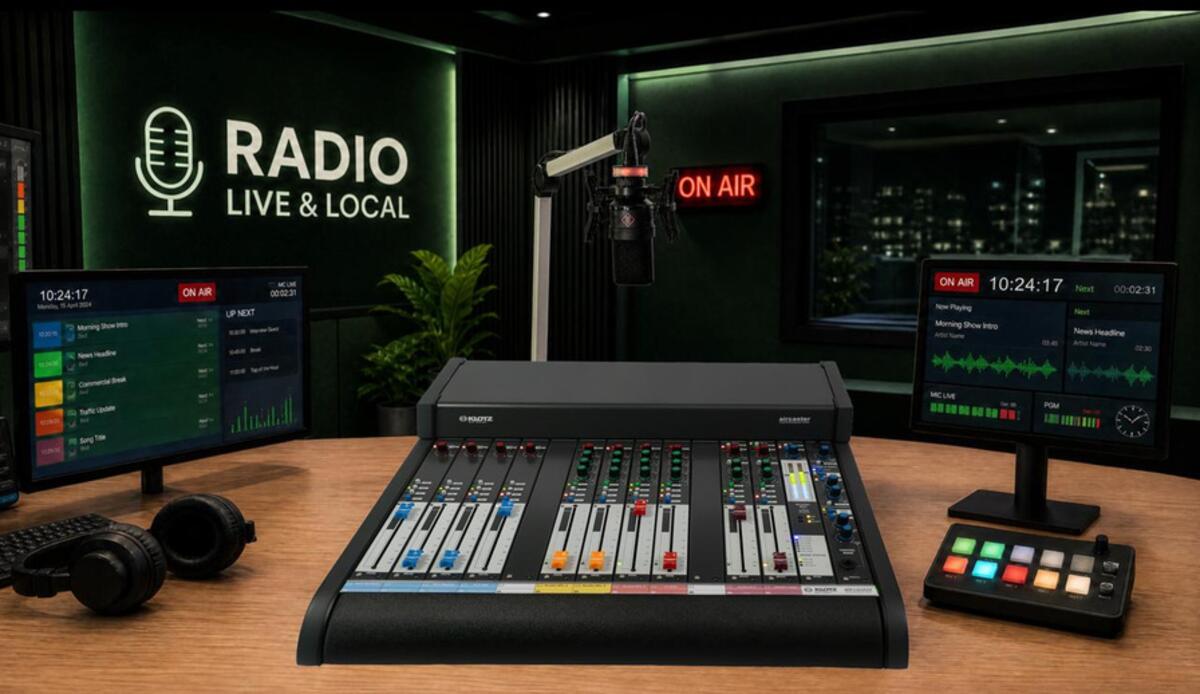
Aircaster is a modular broadcast mixer with built-in digital connectivity, ideal for radio stations without in-house technical support. Its analog audio core has no software to fail, so it’s back on air the instant power returns. Suitable for both production and broadcast operations, in both self-op and tech-op styles.
Aircaster draws on over a century of combined experience in designing, manufacturing and installing radio studios worldwide. Every feature reflects real-world broadcast requirements — not assumptions made in a lab.
Designed and assembled in the UK.
Why a hybrid mixer?
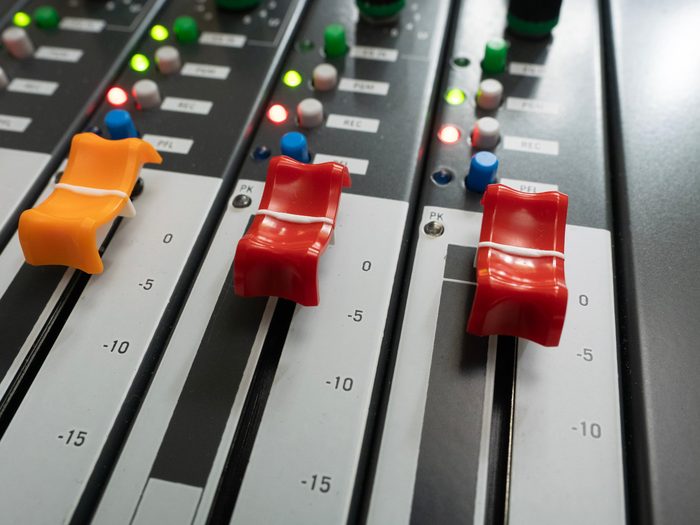
We call Aircaster a hybrid mixer because the word means three things at once — and each one matters.
Analog core, digital connectivity
The audio signal path inside Aircaster is analog — the same technology that captures sound in your microphones and delivers it through your loudspeakers. No listener can tell whether the signal passed through an analog or digital mixer, but the broadcaster certainly can: no boot sequence, no software to configure or update, and operational within seconds of power-on.
Digital connectivity is built in where it adds genuine value: USB soundcards for playout integration, USB output for streaming, and GPIO for studio automation and mic-live signalling.
Production and broadcast in one desk
Many broadcast mixers are great for on-air applications, but lack the features needed during the production process, often requiring a dedicated production mixer. Aircaster handles both. Go live on air or online, record interviews, produce packages, or do all of these in the same session. Separate Program and Record buses, dedicated clean-feed outputs for phone callers, and a versatile monitoring section mean you don’t need two desks or compromise on either workflow.
Self-op or tech-op — your choice
Self-op is fine until you need a technical operator running the desk with the presenter and guests in an adjacent studio — and then some mixers force you to a different desk entirely. Aircaster supports both modes. Self-op presenters get everything within arm’s reach; tech-op setups get talkback, remote guest panels, and clear monitoring of what’s happening next door. Your setup can grow from a single self-op studio to a multi-room facility without changing the mixer.
What it does
Inputs that match your sources
Every module has two user-selectable inputs. Mono modules have balanced microphone and line-level inputs with 3-band EQ. Stereo modules have balanced line-level analog inputs and digital inputs incorporating built-in USB soundcards, so a playout PC connects directly with no external interface. Phone modules accept a direct mobile phone connection, a PC feed or an external telephone balance unit, with cleanfeed selection and off-air talkback to two callers simultaneously.
Comprehensive monitoring and communications
The Monitor module provides independent source selectors for the control room and an associated talks studio, with separate outputs for speakers and headphones. An External Monitor input accepts a feed from an off-air receiver for confidence monitoring. Speakers mute automatically when a microphone goes live, following microphone location. Talkback from a built-in mic with automatic gain control communicates with callers, guest headphones, studio loudspeakers and an optional second control room. An incoming talkback connection supports multi-studio communication. Four-colour high-resolution LED bar-graph meters have switchable VU or Peak ballistics.
Program, Record, and Cleanfeed outputs
Separate Program and Record outputs let you send different mixes to the transmission chain and to a recorder. A dedicated USB output carries either mix to an external streaming encoder or to a recording device. Each of the two Phone modules generates its own outgoing Cleanfeed.
Control and automation
Each mono module provides a GPIO connection for guest cough panels. Each stereo module provides a start pulse or maintained contact for machine control. Independent mic-live contact closures and 12V DC outputs drive external on-air indicators. Auto-cue detection is built into the Master module.
Built to last
All-metal frame with a rigid motherboard and positive module guidance. Alps faders. Sealed switches. Neutrik connectors. SSM 2019 mic preamps and 5532 op-amps — proven components, readily available worldwide. Redundant power supply option. Built-in diagnostics LEDs for quick fault identification.
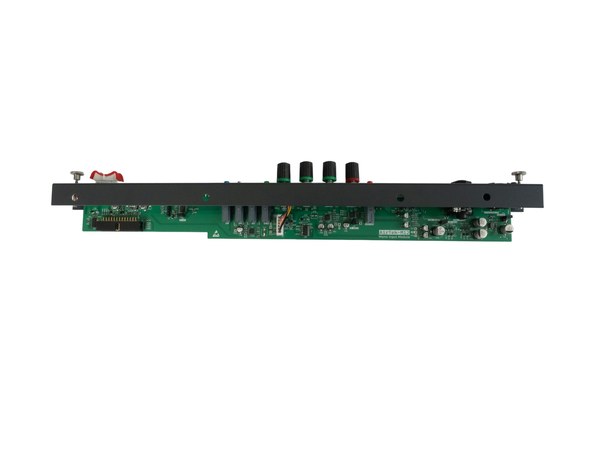
Aircaster mono input module
Designed to be serviced
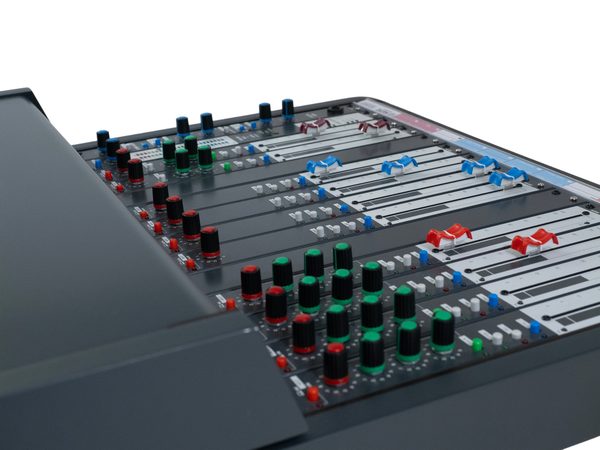
Modules lift out without tools — swap while on air
Every input module can be hot-swapped without powering down the mixer. The rest of the desk stays on air while you replace a module — no downtime, no disruption.
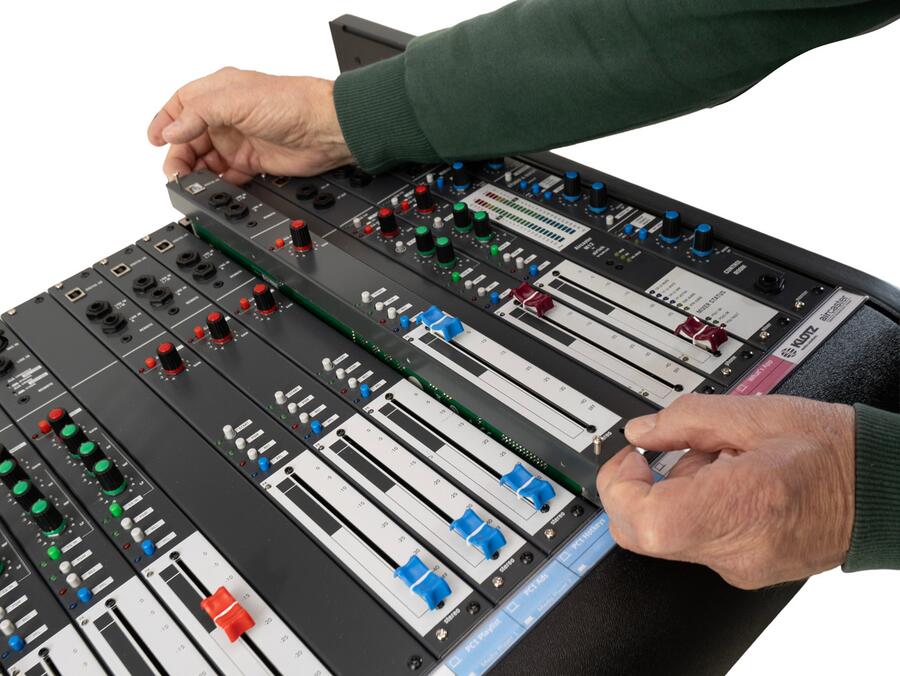
Every channel is a hot-swappable module — swap a single card without taking the desk out of service.
Modules are self-contained, field-replaceable units. Your local KMS partner holds spare modules, so a replacement can be with you quickly rather than shipped from the other side of the world. Built-in diagnostic LEDs help pinpoint faults, and any competent technician can diagnose and repair at board level.
For stations where uptime is critical, a second power supply can be permanently connected. If the primary supply fails, the backup takes over automatically — no interruption to your broadcast.
Connections and control
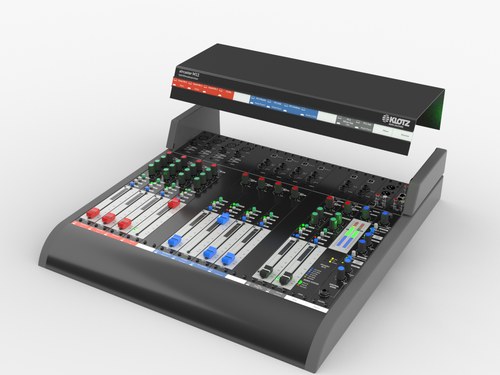
Lift-off lid reveals all twelve module positions and the master section
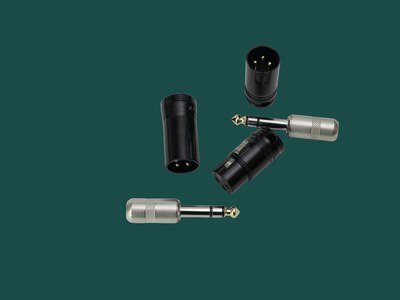
Neutrik XLR and jack connectors throughout
Mono input modules
3.5mm TRS jack per channel for external guest panels with illuminating pushbutton. Mic fader down activates PreFade monitor talkback; fader up enables Cough (mute) function.
Stereo input modules
3.5mm TRS jack per channel carries an opto-coupled contact closure for external START control, configurable pulsed or maintained, with tally-back LED.
Mic live outputs
Independent contact closures drive external MIC LIVE indicators for both control room and studio. 12V DC power outputs (up to 250mA) directly power the indicators.
Multi-studio operation
Monitor module multiway connectors provide easy communication with a dedicated Talks Studio and a second On Air / Production control room, with bi-directional talkback.
Configurations
The M12 is available in three standard module configurations. Mixers are supplied with generic labels and templates for customer-specific labelling. Input modules can be swapped to meet individual preferences, and any combination can be pre-configured to special order.
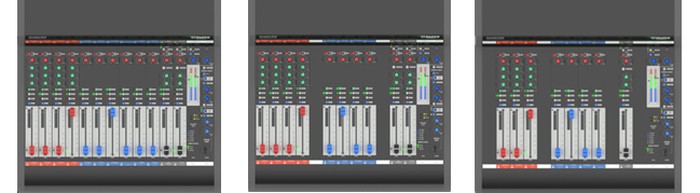
M12A
4 × Mono inputs
6 × Stereo inputs
2 × Phone inputs
M12B
4 × Mono inputs
4 × Stereo inputs
2 × Phone inputs
M12C
3 × Mono inputs
4 × Stereo inputs
1 × Phone input
Accessories
Guest control panels
Available for each guest or co-presenter mic position, with illuminating pushbuttons for cough and talkback.
Articulated mic arm
Pre-wired with XLRs and LED ring at the mic end for high MIC ON visibility. Includes controller for connection to the M12 mic module and guest panel.
Redundant PSU
Back-up 24V power supply for permanent connection, ensuring uninterrupted operation in the event of a primary supply failure.
Mic live indicator
Wall-mounting indicator driven directly from the M12 — no external supply required. User-selectable flash rate.
Typical Performance
Unless otherwise stated, all measurements are made at the PROGRAM outputs into a 10 kΩ load. Frequency response measurements from 20 Hz to 20 kHz. Noise measurements over 20 Hz–20 kHz bandwidth with an RMS responding device. Mic noise from a 200 Ω source resistance; line noise from a zero ohm source. Measurements made with EQ out, faders fully open unless otherwise stated. 0 dB corresponds to 775 mV.
Mix Noise
| 10 modules routed to PGM bus, faders down | −90 dB |
| 10 modules routed to PGM bus, 4 faders open, line inputs at 0 dB gain | −86 dB |
Isolation
| Fader offness | >80 dB |
| Bus de-routing | >80 dB |
| Mic cough | >80 dB |
| Speaker cut (muting) | >80 dB |
Performance
| Frequency response (any input to any output) | +0 / −0.5 dB |
| THD (any input to any output at any gain setting) | < 0.1% |
| MIC input noise at 70 dB gain | −57 dB (EIN = −127 dB) |
| MIC input noise at 50 dB gain | −74 dB (EIN = −124 dB) |
| LINE input noise at 0 dB gain | < −86 dB |
| CMRR (mic or line input) | >50 dB |
| Crosstalk (stereo channels) | <70 dB |
| L/R channel difference (stereo channels) | Within 1 dB, typically 0.5 dB |
Inputs
| MIC input gain range (Hi gain position) | 50 to 70 dB |
| MIC input gain range (Lo gain position) | 30 to 50 dB |
| MIC input user gain range | 0 to 20 dB |
| MIC input impedance | 10 kΩ |
| LINE/TEL input impedance | 20 kΩ |
| LINE/TEL input user gain range | ±10 dB |
| USB inputs | Fully compliant with USB 1.1 |
Outputs
| PROGRAM output impedance | 50 Ω balanced |
| RECORD output impedance | 50 Ω unbalanced |
| CLEANFEED output impedance (phone channels) | 100 Ω balanced |
| Control room LS output (stereo) | +5 dB for 0 dB at PGM out, 50 Ω, unbalanced |
| Studio LS output (mono) | +5 dB for 0 dB at PGM out, 50 Ω, balanced |
| Cleanfeed rejection (phone channels) | >70 dB |
| USB outputs | Fully compliant with USB 1.1 |
Equalisation
| Mono input EQ | ±10 dB at 8 kHz, shelving ±10 dB at 630 Hz, bell ±10 dB at 40 Hz, shelving |
| Phone input EQ | ±12 dB at 3 kHz, shelving ±12 dB at 160 Hz, shelving |
Physical
| Footprint | 536 mm (width) × 560 mm (depth) |
| Weight | 7.5 kg |
| Power | External DC 24 V, 40 W; mains input 100–240 V 50/60 Hz |
Ready to find out more?
Whether you’re planning a new studio or upgrading an existing one, we’re here to help.